The Truth About Slopes
If you’ve ever tried to design outdoor stairs on a slope, you know the truth:
It’s the kind of project that looks simple until you actually try to do it.
Pinterest will give you 200 photos of perfect Japanese moss stairs and Tuscan stone steps… but zero guidance on how to make them work on your slope, with your materials, in your space.
That’s why when one of our users recently used GardenDream to design outdoor stairs — not a garden, not a flower bed — it was a refreshing change.
Too many homeowners make the mistake of thinking landscaping is just about plants.
But as this user proved, the structure—the stairs, the paths, the hardscaping—is actually the backbone of your garden. If you get the stairs wrong, the best plants in the world won’t save the design.
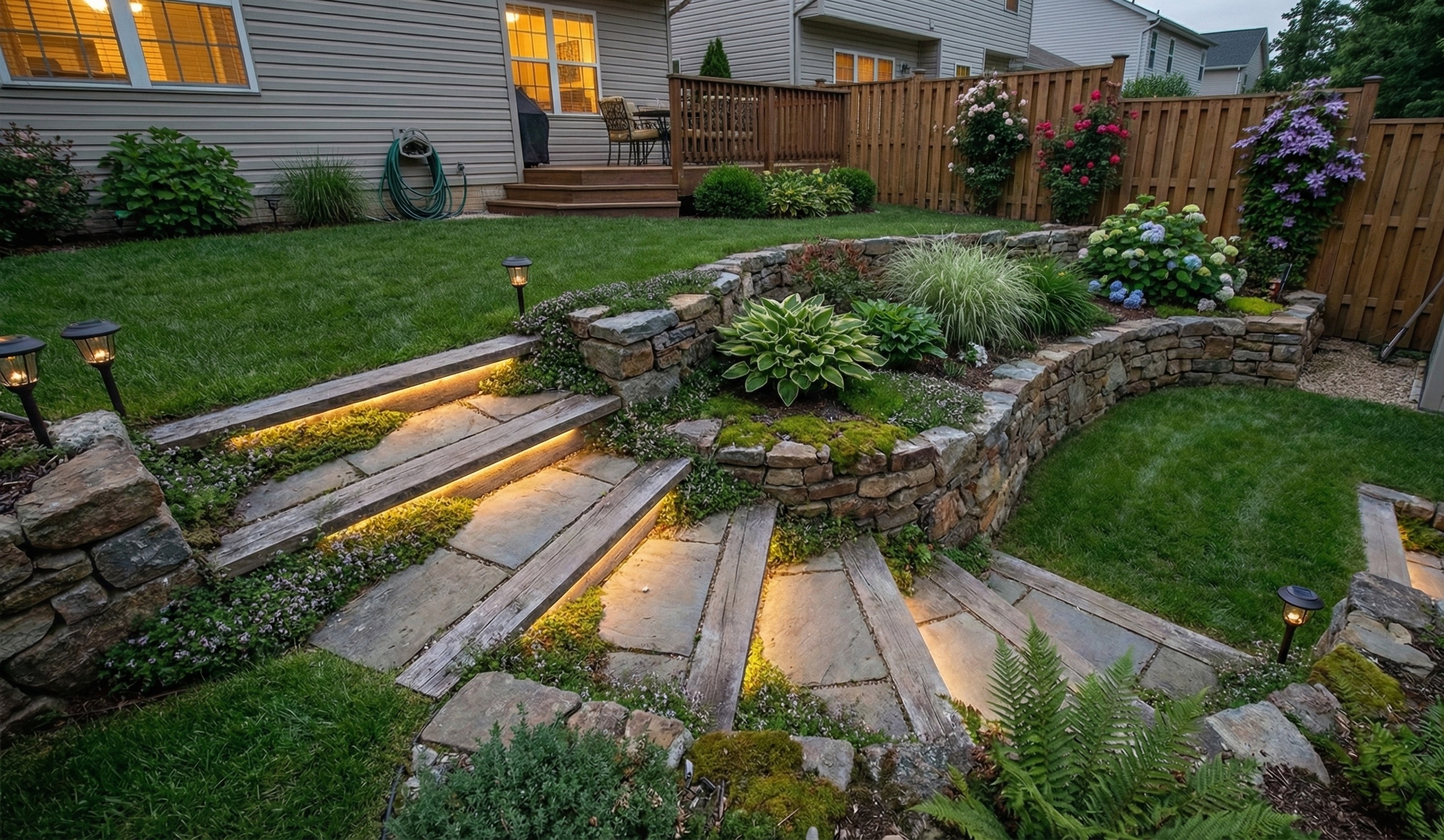
1. Think About Flow Before Materials
Before choosing stone, wood, gravel, or concrete, ask one question:
“How should people move through this space?”
Most outdoor steps fail because:
- They’re too steep
- They feel awkward to climb
- They don’t connect naturally to paths or terraces
- They interrupt the visual rhythm of the garden
Instead of designing the stairs first, design the movement path, then shape the steps around it.
GardenDream actually excels here — it predicts the natural line of travel and generates steps that follow the slope’s logic, not your battle with it.
2. Break the Slope Into Chapters
A slope is not a single incline. It’s a story with multiple beats:
- A short flat landing
- A small climb
- A widen-out moment to catch your breath
- A curve around a tree
- A long view axis
- A final transition to the upper level
Think of steps as paragraph breaks in the terrain. Great outdoor stairs don’t fight the slope — they translate it.
3. Use the “Rule of Comfort”
This rule comes from architecture but works beautifully outdoors:
2 × Risers + Tread ≈ 63–65 cm
Example:
- 14 cm rise
- 35 cm tread
Pro Tip: Don’t copy your indoor stairs. Indoor steps usually have a steeper 17–18 cm rise, but outdoors, that feels exhausting—almost like climbing a ladder. For a relaxed garden feel, keep your rise under 15 cm (6 inches). These feel gentle, safe, walkable — and timeless.
If the slope is shallow:
- Use medium rises
- Use long treads
- Add moss, gravel, or groundcover in between
If the slope is steep:
- Use lower rises
- Add more treads
- Insert landings every 4–6 steps
This turns a difficult terrain into something elegant and easy to climb.
4. Anchor the Steps Into the Landscape
The biggest mistake? Floating steps that look pasted on.
Use the environment to “lock” the stairs visually:
- Tuck them into the slope
- Use retaining edges on one side
- Wrap steps around a boulder or tree
- Embed them between planting pockets
- Slightly overgrow edges for softness
When GardenDream generates step layouts, it tends to anchor them automatically — a very human detail that makes designs feel believable.
5. Mix Hardscape + Softscape
A pure concrete staircase looks like a fire escape. Pure logs look like a campground.
But the best stairs blend materials:
- Stone steps + creeping thyme
- Timber risers + gravel treads
- Floating concrete slabs + mondo grass
- Rustic boulders + ferns + moss
- Steel edges + decomposed granite + sedges
The trick is contrast: rigid geometry + organic softness. It makes the stairs feel alive — not engineered.
6. Create a View Moment
Every stairway needs a “reward moment” at the top or on a landing:
- A framed view
- A bench
- A sculptural plant
- A tree canopy
- A small water feature
- A wide reveal into the garden
This transforms stairs from a necessity into an experience.
When we tested this in GardenDream, designs that included a “reward moment” had dramatically higher user satisfaction — people feel the difference instantly.
7. Design With Light
Nighttime steps are more than safety — they’re theatre.
Add:
- Under-tread strip lighting
- Soft bollards
- Recessed riser lights
- Stone-side glow
- Solar path lights in staggered rhythm
Lighting transforms stairs from “functional” to “magical”. And magic is a form of landscaping.
8. Use Generative Design for the Hard Part
Here’s the truth: designing outdoor stairs manually is frustrating.
- You don’t know how many steps you need.
- You don’t know where the landings belong.
- You can’t visualize how the slope interacts with materials.
- You can’t test multiple ideas quickly.
That’s exactly why GardenDream users started doing this. In seconds, you can see different geometries, materials, flows, and connections to paths and terraces. It’s like having a landscape architect in your pocket — minus the spreadsheets and site visits.
Final Thought: Yes, stairs are landscaping.
Maybe the most underrated kind.
They shape how we move, how we see, and how we experience the outdoors. Whether your slope is gentle or dramatic, stairs are an opportunity — not a problem. Design them as part of the landscape, not on top of it, and your entire garden transforms.
Ready to stop dreaming and start designing?