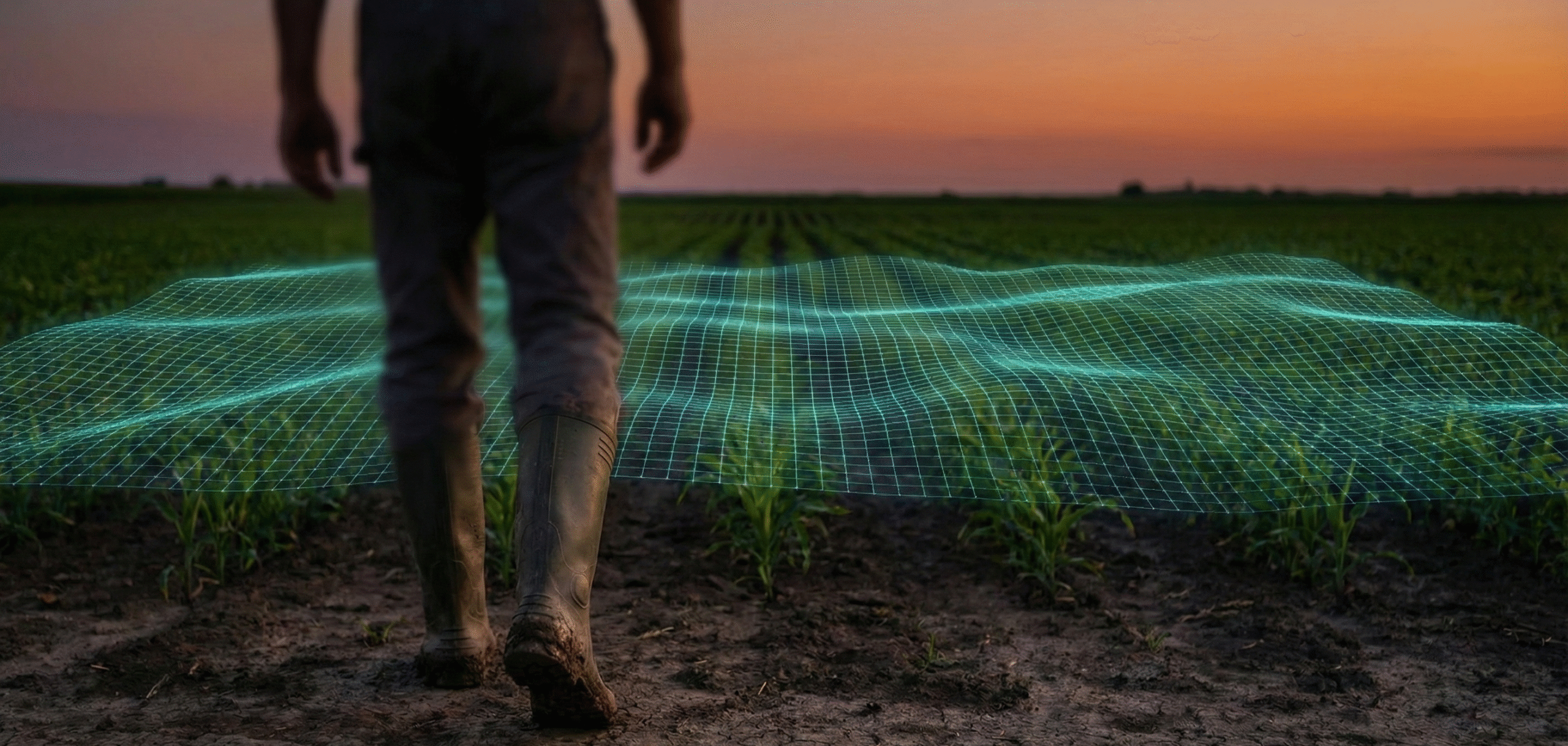
For generations, agronomy has been defined by a simple, physical rhythm.
- You walk the field.
- You observe.
- You make a decision.
- You leave.
Time moves on.
But here is the hard truth that defines the ceiling of modern yields: crops do not grow in episodes.
Biology is continuous. It is relentless. While we sleep, while we plan, and while we are away, the crop is progressing. The most critical losses, the ones that separate a good year from a record year, occur almost exclusively in narrow biological windows that open and close between our visits.
We have reached the limit of what the human eye, checking in once a week, can achieve. A new class of intelligence is beginning to expose that ceiling.
In recent seasons, a growing number of growers using Agrio have begun interacting with a continuous field-intelligence layer inside the platform, Harvie.
It was not introduced as a new “tool.”
It appeared as a persistent field presence: a system that remains attached to specific plots, remembers cultivar identity and stage progression, and continues to reason about biological risk even when no one is actively checking the field.
What these growers are testing is not whether another app can give advice, but whether a field can be continuously accompanied.
Quietly, and without publicity, these fields are beginning to behave differently.
The Problem: The Silent Degradation
We tend to think of yield loss as a catastrophic event, a storm, a pest outbreak, a drought. But most yield is stolen silently, in increments, through invisible degradations:
- Cellular collapse during brief heat spikes.
- Impaired flowering integrity occurring overnight.
- Transient nutrient lockouts lasting only hours.
- Cumulative water stress that shows no visible wilt until it is too late.
These events do not trigger alarms. They do not immediately discolor leaves. They simply lower the biological potential of the plant, invisibly and permanently.
By the time symptoms appear during a field visit, the damage is already part of the plant’s history. A continuous biological process cannot be governed by periodic inspection.
What We Are Starting to Observe
Across fields using continuous field-intelligence systems, including Harvie, a pattern has quietly emerged.
The most noticeable change is not dramatic rescue events. It is the gradual disappearance of unexplained losses. Growers begin reporting:
- More stable flowering.
- More consistent fruit set.
- Fewer “mystery” stress episodes.
- Fewer late-season surprises.
- Fewer decisions made “just in case.”
This happens not because more inputs are applied, but because damage is being prevented before it begins.
From Dashboards to Guardianship
Most digital tools still mirror the old model: dashboards, static maps, and post-factum analysis. They improve visibility, but they do not change the control structure.
Harvie and systems like it operate differently. They maintain persistent biological memory of:
- Cultivar identity
- Phenological progression
- Accumulated stress load
- Prior interventions
- Local weather coupling
This memory is not descriptive. It is predictive.
A temperature that is harmless in vegetative growth becomes dangerous during fruit set. A mild deficit in one cultivar becomes catastrophic in another. These systems operate on that coupling, continuously.
A New Control Layer
This is not simply better data. It is a shift from episodic advisory to continuous biological control.
It represents a new layer permanently attached to the field: continuously aware, temporally predictive, and intervening before damage manifests.
Intervention moves from precautionary to precise. From reactive to preventive. From episodic to continuous.
The Overlooked Transition
Much of the industry frames AI as automation, doing familiar work faster. But what is quietly forming is something more fundamental: Digital guardianship over biological systems.
The important development is not that agriculture is adopting computers. It is that biological production is acquiring permanent memory and continuous awareness.
Once this layer exists, farming without it becomes structurally inferior, not technologically outdated.
We are moving beyond the walk. We are entering the era of the field that remembers, anticipates, and protects itself.