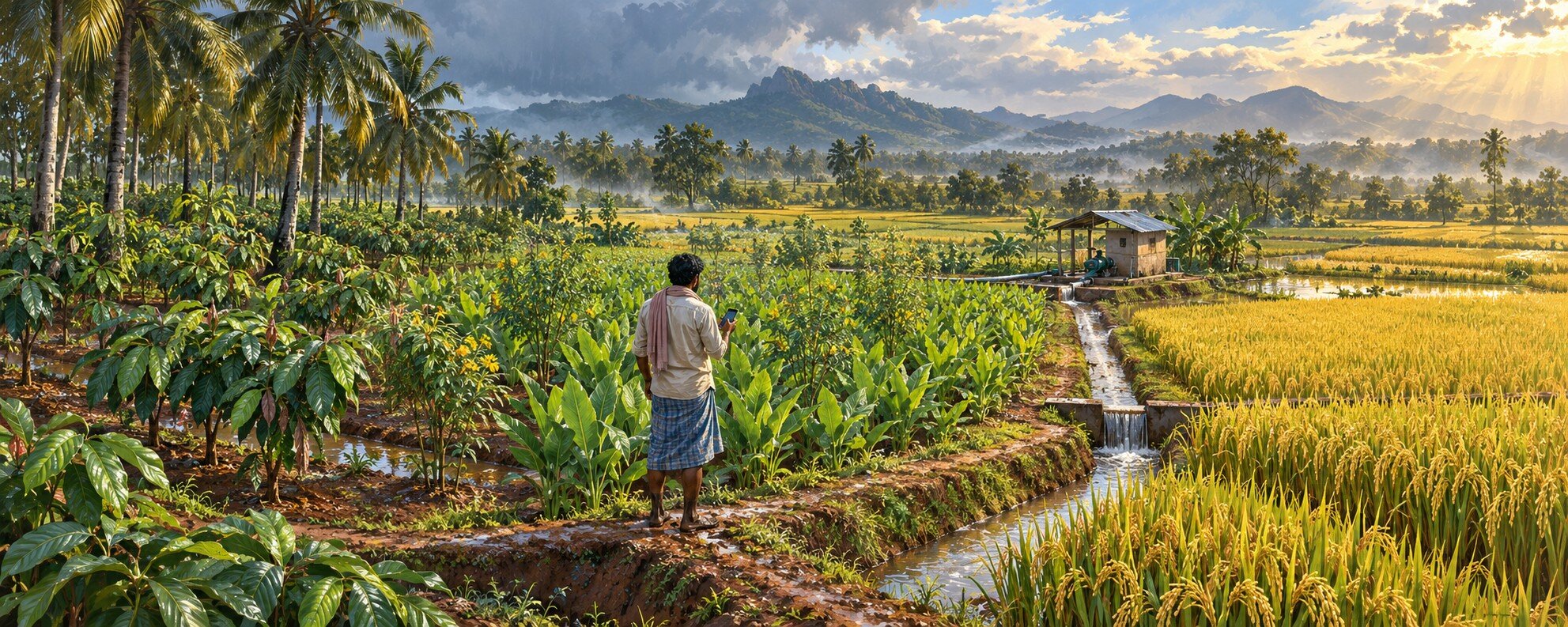
A family farm, a drought year, a four-day power cut and one evening of rain. What an AI agronomist can do when it knows the whole farm.
Small farms rarely grow one crop. They grow five, planted at different times on different soils, sharing one pump and one pair of hands. The same shower is good news for one crop, a drainage problem for the next and a harvest risk for a third. Advice that knows one crop at a time misses how a small farm actually runs.
Take a family farm in southern India:
- ten and a half acres of oil palm, about 600 palms, most of them planted in 2017
- a young cocoa planting in its first year
- turmeric intercropped with red gram
- a traditional paddy crop on sandy loam, heading into grain fill
One borewell and two electric motors water all of it.
Harvie, Agrio’s AI agronomist, knows this farm the way a good farm manager does. It knows every block, what’s growing there, what was done last and what comes next. It keeps the season’s harvest record. It reads the satellite scans of the farm, the forecast for every field, and Agrio’s growth-stage and risk models for every crop. And it remembers all of it from one conversation to the next. Here’s what AI for smallholder farmers looks like when it knows the whole farm, over a few weeks in October.
The season, in numbers
Every harvest goes into the conversation: the date, the weighbridge kilos, the days since the last cut. Harvie keeps the running total.
By early October the oil palm had delivered 81.6 tonnes since April, or 7.8 tonnes per acre, against a season target of about 103 tonnes. Harvie knew why the year was behind. The February–March El Niño drought was always going to hit bunch numbers months later. It also knew what the rest of the season had to deliver: about 21 tonnes more by March.
The record caught something else. Over the season, the farm’s harvest totals and the mill’s weighbridge receipts had drifted about 2 tonnes apart, roughly 3% of the crop. The farmer took the numbers to the mill and had the difference corrected.
Four days without water
Then the motors stopped. An electrical fault kept the pumps off for four days in a dry spell. The farmer’s question was the one every irrigated grower asks after an outage: did it hurt?
Harvie went to the satellite record for the block:
- During the outage, the red-edge index (the one most closely tied to leaf chlorophyll) dropped from 0.45 to 0.33 across the block.
- By the next scan, five days after the motors came back on, red-edge was up to 0.52 and NDVI had climbed from 0.77 to 0.85.
- There were no decline alerts, only a few lighter patches worth walking.
Harvie also explained what a satellite can’t show yet. In oil palm, water stress during flower development turns up in bunch numbers many months later. So the answer had three parts:
- The canopy came through.
- Walk the lighter patches over the next three weeks, looking for leaf folding or tip burn.
- Log the outage, so that if bunch numbers dip next year, the farmer knows why.
One evening of rain
The next day, the rain came. The farmer sent one line: "We have a good spell of rain today." Harvie answered for every crop on the farm:
- Oil palm:
- Keep the motors off for at least two to three days.
- Tomorrow, dig 10–15 cm in a few spots. If the soil is still moist, the motors stay off.
- Drain any palms standing in water within 24 hours.
- Cocoa: the plants were earthed up the week before, and the rain is a free carrier for their next fertilizer drench. Apply it once the basins drain, never onto standing water.
- Turmeric and red gram:
- Walk the low ends of the beds for standing water.
- Hold irrigation until the top 5–7 cm dries.
- Save the second wood-ash dose for when the soil is firm, not sticky.
- Paddy at milk to dough:
- On free-draining sandy loam, lodging from this rain alone is unlikely.
- Stop ponding the field.
- Once the grain reaches hard dough, the next strong wind or heavy rain is the signal to harvest three to four days early rather than wait for full color.
Harvie didn’t need to ask a single question first. It already knew how much rain had fallen, the crops and their modeled growth stages, the soils and the last operation on every block.
Ten days later: the paddy
Agrio’s growth-stage model put the paddy at hard dough just as the forecast for the field turned: strong wind and about 40 mm of rain within 48 hours. At that stage, one wet, windy night can flatten heavy panicles and start grain sprouting on the plant. Cutting a few days early costs far less than a lodged crop.
Harvie flagged it two days ahead. The farmer cut early, and the crop was in before the storm.
By the numbers
- 2–3 days of pumping saved after a single rain
- 4 days without irrigation, checked against the satellite record in one conversation
- 2 tonnes of oil palm recovered at the weighbridge
- 1 paddy crop harvested before the storm
What Harvie knows without being told
Much of what Harvie knew that October, nobody typed in. Agrio’s remote sensing and prediction models run on every mapped field:
- Satellite monitoring: vegetation and chlorophyll indices for each block, with alerts when part of a field starts to decline.
- Hyperlocal weather: the forecast for each field’s location, and the rain that has already fallen there.
- Growth-stage models: heat units and chill hours accumulated since planting, predicting when each crop reaches its next stage.
- Risk models: frost, heat, wind, heavy rain and disease pressure, weighed against each crop and its stage.
The farmer’s own record sits on top of that: harvests, operations, and what they see in the field. Harvie brings both to every answer.
Why whole-farm context matters for programs that support small-scale farmers
Nothing in those weeks was exotic agronomy. What made the advice good was context: the right crop, stage, soil and history, at the moment the farmer asked. That’s what an extension officer brings on a good visit, and what’s missing between visits. It’s the gap digital agricultural extension is meant to close.
Advice for the farm, not the crop
Small farms are diversified by design: intercrops, staggered plantings, a cash crop beside a food crop. Harvie reasons across all of them at once, so one question about rain, heat or a power cut gets an answer for every block.
Water and energy, where both are scarce
Where pumps depend on unreliable power and groundwater is falling, every day the motors stay off matters. Harvie bases irrigation on the field’s own forecast, the soil and a simple field check. Farmers pump when the crop needs water, not out of habit.
Climate resilience, one decision at a time
Drought years, extreme rain and heat reach small farms as a string of daily decisions. Harvie’s weather and growth-stage alerts turn each forecast into a decision for that crop at that stage: keep the motors off, time the fertilizer, cut the paddy early.
A farm record that builds itself
Harvests, operations and observations go in as conversation and come out as a record: season totals, yield per acre, and the dates that explain a bad year. It’s the kind of record that helps when a farmer sits down with a buyer, a lender or a cooperative, and nobody has to fill in a form to keep it.
Extension between visits
Field staff can’t be on every farm every week. Harvie is there between visits, in the farmer’s own language. It keeps each farm’s history, so the next visit starts where the last conversation ended.
Your agronomists in the loop
Agrio Workgroups give a program its own private channel, where your agronomists and the farmers they support work from the same fields, alerts and records. Supervisors follow activity across the program from one dashboard and step in where a farm needs a person.
What Harvie doesn’t do
- It doesn’t replace a field visit. Satellite scans and forecasts show where to look. The field shows what’s there.
- It doesn’t make the call. Harvie lays out the agronomy and the options. The farmer decides.
Getting started
If you farm:
- Map every block and set its crop, variety and planting date.
- Tell Harvie about intercrops and anything else the map doesn’t show.
- Tell Harvie what you do: harvests, irrigation, fertilizer, the day the pump broke.
- Ask about the whole farm: "It rained last night. What now?"
If you run a farmer-support program:
- Start a Workgroup and invite your agronomists and farmers. Start a trial.
- Map farms block by block with each farmer.
- Let Harvie carry the daily decisions, and point your team’s visits at the farms that need a person.
Frequently asked questions
What does AI for smallholder farmers look like in practice?
It starts from the whole farm: every block, crop, stage and soil, the forecast for each field, and the farm’s own history. One message about rain gets an answer for every crop.
Where does Harvie’s information come from?
From two places. The first is Agrio’s remote sensing and prediction models, which run on every mapped field: satellite monitoring, the hyperlocal forecast, growth-stage models built on heat units and chill hours, and weather and disease risk models. The second is the farm’s own history: the harvests, operations and observations the farmer shares.
Does Harvie work on mixed and intercropped farms?
Yes. Harvie keeps track of every block and what’s growing in it, intercrops included, and reasons across all of them at once.
Can Harvie replace extension officers?
No. Harvie carries the daily decisions between visits, with each farm’s history in hand, so extension staff can spend their time where a person is needed. Agrio Workgroups keep your agronomists in the same channel as the farmers they support.
What do farmers need?
A smartphone, the Agrio app and a data connection. Harvie is multilingual, so farmers can ask in their own language.
Is Harvie free?
Free Agrio accounts include a limited number of Harvie messages. Satellite scans come with supported plans. For programs, Agrio Workgroups add a private channel for your team and the farmers you support.
Start with a few farms and one season
If your organization supports small-scale farmers, pick a handful of diversified farms, map every block and let Harvie run alongside your field team for a season. Start a Workgroup trial, or read more about Harvie, Agrio’s AI agent for agriculture.